Sick Leave & the Bradford Factor: Measuring BGM Metrics Correctly
Why Metrics Are the Foundation of Every BGM Program
No data, no BGM — at least not one with lasting impact. Many companies launch health programs based on gut feeling: a sense that morale is low, a perceived high number of sick days, rumors about turnover. What's missing is a reliable data foundation that shows where the real problem lies and whether measures are actually working.
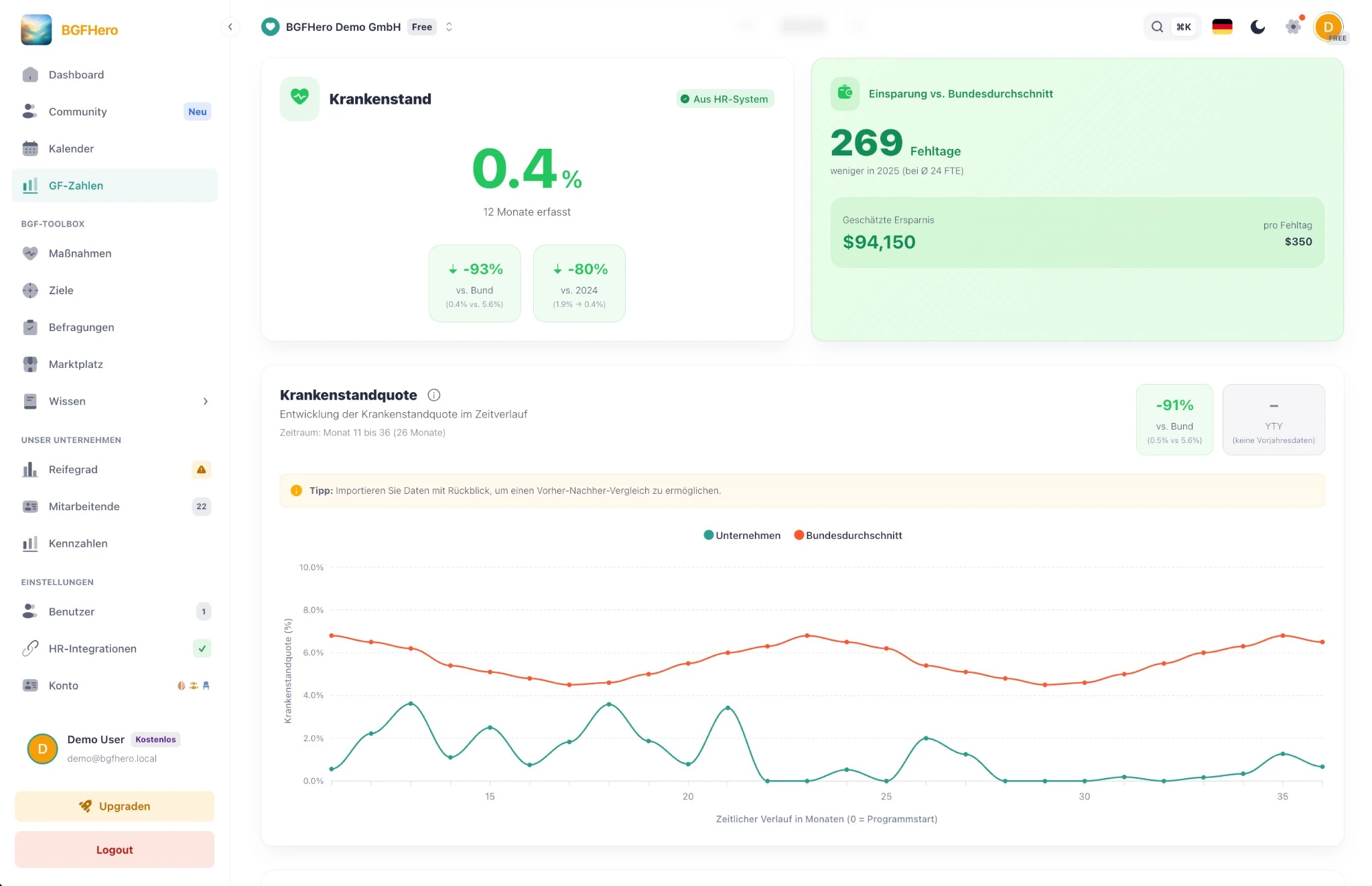
The three most important BGM metrics are the **sick-leave rate**, the **turnover rate**, and the **Bradford Factor**. The sick-leave rate results from illness-related absent days relative to scheduled working time — expressed as a percentage. According to the official statistics of the German Federal Ministry of Health (KM1), the German national average was **5.66%** in 2025. If your figure is consistently above that, it's a clear signal that action is needed. If it's consistently below that, it would be naive to assume everything is running optimally — it may simply mean that people who should be calling in sick aren't (presenteeism).
Bradford Factor: Frequency Beats Duration
The Bradford Factor reveals what a plain absence rate conceals: someone who's briefly sick three times puts more strain on the company than someone who is out once for two weeks. The formula is:
**B = S² × D**
Here, **S** stands for the number of absence episodes within the observation period (e.g., one year) and **D** for the total number of absent days. Example: three sickness episodes of two days each result in B = 3² × 6 = **54**. A single illness lasting six days results in B = 1² × 6 = **6**. There are no universally valid limits; literature and practice set the bands differently. Our metrics analysis places each person's score over the last twelve months in four fixed bands: **below 50** normal, **50–124** elevated, **125–399** high, **400 and above** critical. These are guide values – they say nothing about the cause and do not replace a conversation.
Important: the Bradford Factor is not a disciplinary tool, but an early-warning signal. It helps identify potential strain situations early — before they escalate. Scores per person are based on sick notes and are therefore health data (Art. 9 GDPR). In Germany, a works council, where one exists, has a say in such an analysis (Section 87(1) No. 6 of the German Works Constitution Act, BetrVG). That is why the Bradford Factor is switched off by default here; it is switched on deliberately in the metrics data entry once the basis has been clarified.
From Spreadsheet to Automated Analysis
The most common mistake in practice: sick-leave rates and the Bradford Factor are maintained in Excel — with all the familiar problems. Manual entry errors, outdated export data from the HR system, no historical comparability. Anyone who wants to produce monthly reports ends up spending more time maintaining data than analyzing it.
Better: the raw data comes directly from the HR system — Personio, DATEV, or rexxHR — and is analyzed automatically. This produces trend curves across quarters, department comparisons, and early outlier alerts, without anyone having to type in a single number by hand. Management reporting then takes a few clicks instead of half a working day.
How to put it in place
- 1Connect your HR system: Connect Personio, Factorial, rexx, Lucca or Kombo via the interface; you'll need the API credentials of your HR system. Without an interface, upload a DATEV export as a CSV or Excel file.
- 2Analyse periods and groups: The metrics show each month, the last twelve months and full years, each compared with the previous year. From the Manager role, you can break down sick leave rate and turnover by department, location, cost centre, gender or age group; groups of fewer than five people stay hidden.
- 3Switch on the Bradford Factor only deliberately: It is off by default. It is switched on in the data entry via "Record extended data (Bradford factor)". Scores per person are health data (Art. 9 GDPR); in Germany, a works council, where one exists, has a say (Section 87(1) No. 6 of the German Works Constitution Act, BetrVG) – clarify this first. EasyBGM places the scores in fixed bands: below 50 normal, 50–124 elevated, 125–399 high, 400 and above critical. These are guide values, not a standard.
- 4Set a sick leave target: Under Goals, create a sick leave goal with a baseline, target value and deadline. The metrics automatically compare your rate with the German national average for the same months (official KM1 statistics of the German Federal Ministry of Health) and with the previous year.
- 5Share figures with executive leadership: Under Management figures, select the sections and send them by email – or share a link with a PIN.
What you need
- Effort
- under 30 min
- Cost
- Free
- Duration
- 4 Wochen
- Setup
- 45 min
- ✓ No more manual data upkeep: HR data flows automatically into the BGM analysis.
- ✓ Early warning system: Clusters of short-term illnesses become visible before they turn into serious problems.
- ✓ Demonstrable impact: Trend curves across quarters and years make the success of BGM measures measurable.
- ✓ Less reporting effort: Monthly BGM reports are created with a few clicks instead of half a day of Excel work.
Eligible for funding: up to €600 tax-free
As part of a structured workplace health process, this measure is tax-free under § 3 no. 34 of the German Income Tax Act (EStG) up to €600 per employee per year — BGF-Kompass supplies the process. Certified offers (e.g. from Upfit) are additionally subsidised by statutory health insurers under § 20b SGB V.
Health-insurer funding & tax: how to apply →Adopt it for your company
Register for free — and the measure is ready to go in your cockpit: invitation, feedback survey and appointment are already set up. First cycle, first numbers for the boss.
Start for free nowRather take a look first? To the live demo →
Contributes to
Action field
Governance & Compliance →A fitting occasion
Related best practices
Not sure where to start? 5-minute self-check →