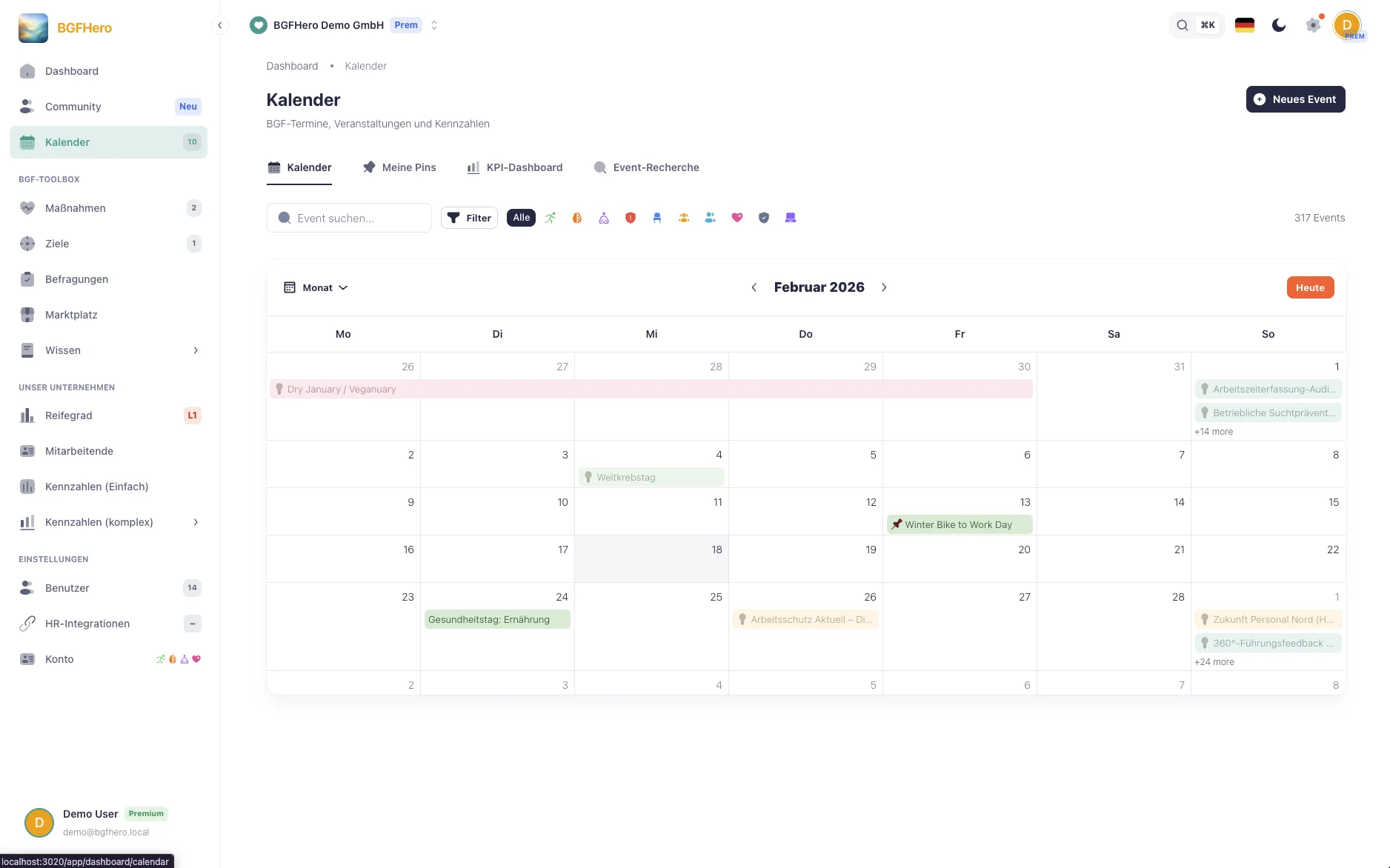
BGM Annual Planning: Structured Planning with the Health Calendar
Why an annual plan makes BGM sustainable
Many know the typical pattern: back courses in January, a flu-shot appointment in October — and little happens in between. Activities emerge reactively, whenever time or budget happens to be available. The result: employees don't perceive BGM as a continuous offering, but as sporadic one-off events.
A structured annual plan changes this fundamentally. When measures are spread across the year and thematically coordinated, a rhythm emerges. Employees know what to expect — and that measurably increases the participation rate. At the same time, you can plan resources ahead of time: book external providers in good time, allow lead time for communication, and distribute budgets cleanly across quarters. For leadership, you also have a clear document that makes BGM visible as a strategic investment — not as a cost factor without a plan.
Using seasonal health occasions as hooks
The year offers over 310 established health occasions: World Health Day (April 7), Back Health Day (March 15), Mental Health Awareness Month (October), Colorectal Cancer Awareness Month (March), World Sleep Day (June 19) — to name just a few. These occasions aren't a PR gimmick. They serve two practical functions.
First, they give your BGM external legitimacy: when a campaign runs for World Heart Day, you don't need to justify it internally — the hook is well-known and recognized. Second, seasonal factors determine which topics are relevant at any given time anyway. Back and movement topics land well in spring, when many people want to become active again after winter. Stress management and recovery resonate especially well after summer and before the year-end sprint. Nutrition topics do well in January. You're swimming with natural attention currents instead of against them.
The health calendar in EasyBGM lists these 310 occasions with date, category, and a direct link to measure assignment. You don't have to reinvent the wheel — just choose what fits your workforce.
3–4 activities per quarter: how not to overreach
The most common mistake in annual planning is over-ambition: too many measures at once, too little lead time, too much coordination effort. A realistic pace is 3–4 activities per quarter — that's one impulse per month with a calmer week as buffer.
Plan one anchor theme per quarter (e.g., Q1: movement & back health, Q2: mental health, Q3: nutrition & energy, Q4: resilience & year-end wrap-up) and select 2–3 complementary individual measures underneath it. This creates depth instead of breadth. For measures funded by statutory health insurers under § 20b: these often need to be coordinated with the funding body 8–12 weeks in advance — so plan them deliberately into Q4 of the prior year or, at the latest, the Q1 kickoff. EasyBGM shows you directly in the calendar which occasions suggest measures eligible for statutory health insurance funding, and automatically sets reminders for the booking lead time.
How to put it in place
- 1Open the seasonal calendar: In EasyBGM, open the "Calendar" section and switch to the annual overview. You'll see all 310 predefined health occasions with date and category. Filter by area (movement, mental health, nutrition, prevention) to get an initial overview of what's relevant to your organization.
- 2Select and prioritize occasions: Drag and drop to mark 10–15 occasions that fit your workforce and budget. Aim for a balanced distribution across all four quarters. Use the category filters to specifically flag occasions eligible for statutory health insurance (GKV) funding (Section 20b) — EasyBGM automatically marks these with a funding badge.
- 3Assign measures: Link each selected occasion to a concrete measure from the EasyBGM measure library, or create your own. For each measure, define who is responsible, the target group (e.g., shift workers, remote workers, managers), and the rough format (workshop, digital activity, information campaign).
- 4Set up reminders and lead times: Activate automatic reminders for each measure. By default, EasyBGM sets two reminders: 8 weeks before the date (for external bookings and GKV coordination) and 2 weeks before the date (for internal communication and invitations). Adjust the lead time for GKV-funded measures to at least 10–12 weeks.
- 5Export the executive annual plan: Export the finished annual plan as PDF or XLSX for leadership. The export includes a quarterly overview with measures, estimated costs, target groups, and the GKV-eligible items — ready as a presentation template for your next leadership meeting.
What you need
- Effort
- half a day
- Cost
- Free
- Duration
- 1 Woche
- Setup
- 120 min
- ✓ Even distribution of BGM measures throughout the year prevents reactive gap-filling
- ✓ Seasonal occasions increase visibility and employee willingness to participate
- ✓ Timely planning secures GKV funding under Section 20b and avoids booking bottlenecks
- ✓ A transparent annual plan strengthens leadership's confidence in BGM as a strategic program
Eligible for funding: up to €600 tax-free
As part of a structured workplace health process, this measure is tax-free under § 3 no. 34 of the German Income Tax Act (EStG) up to €600 per employee per year — BGF-Kompass supplies the process. Certified offers (e.g. from Upfit) are additionally subsidised by statutory health insurers under § 20b SGB V.
Health-insurer funding & tax: how to apply →Adopt it for your company
Register for free — and the measure is ready to go in your cockpit: invitation, feedback survey and appointment are already set up. First cycle, first numbers for the boss.
Start for free nowRather take a look first? To the live demo →
Contributes to
Action field
Governance & Compliance →A fitting occasion
Related best practices
Not sure where to start? 5-minute self-check →