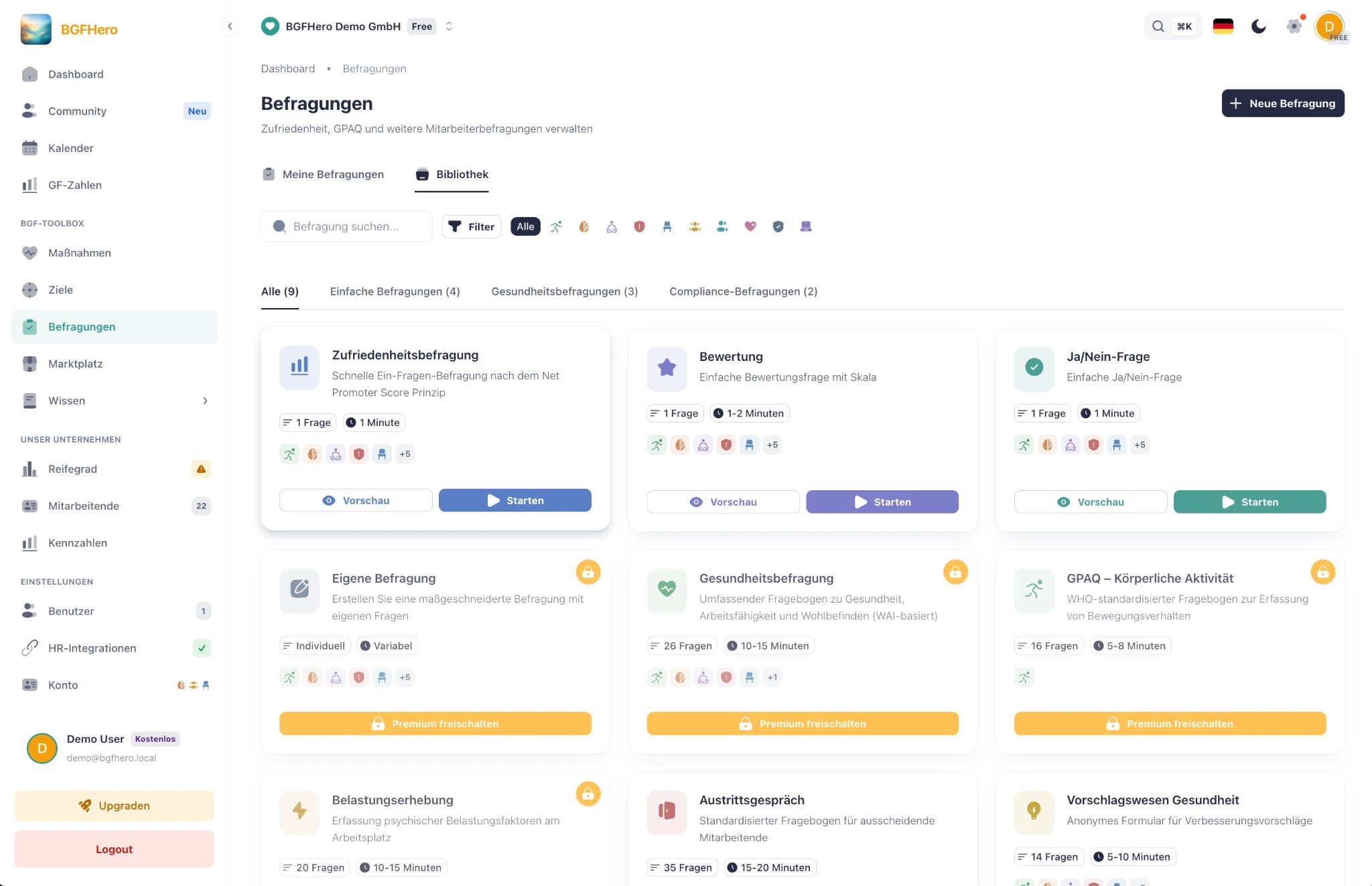
Micro-surveys in BGM: Honest feedback in 60 seconds
Many BGM managers know the problem: you've run a measure but don't really know what the workforce thinks of it. The classic annual survey with 80 questions comes far too rarely and far too late to steer day-to-day practice. Micro-surveys – three to five questions answerable in under 60 seconds – close exactly this gap.
Why short surveys yield more honest answers than long ones
Survey length is the biggest enemy of response rate. Studies consistently show: surveys with five or fewer questions achieve response rates of 60–80 percent, while surveys with more than 20 questions often fall below 20 percent. On top of that comes fatigue – anyone still answering after question 15 often clicks through blindly. The result: lots of data, little signal.
Another factor is anonymity. When a survey is short, anonymous, and accessible without a login – for example via a QR code on the printer or a link in an internal message – the barrier drops significantly. Employees give more honest feedback when they're sure no conclusions can be drawn about their identity. No email address, no department assignment, no metadata from an account that would otherwise be required.
GDPR compliance here isn't a bureaucratic obligation but a trust signal: organizations that communicate transparently that no personal data is being collected get more, and more candid, responses.
Which BGM questions really count
Not every question is equally valuable. Two formats have proven especially effective in workplace practice.
The **Net Health Score** works like the Net Promoter Score, but for one's own sense of health: "How healthy do you feel right now in your daily work – on a scale of 0 to 10?" A single number, collected monthly, shows trends more reliably than any detailed survey. Where the score drops, it's worth looking deeper.
The **Strain Barometer** specifically asks about the three central stressors: workload, leadership behavior, and social support within the team. These three dimensions cover the core of psychological strain at work – validated by the internationally used COPSOQ instrument. Short surveys built on these dimensions deliver actionable results instead of a general mood snapshot.
Important: always repeat questions with the exact same wording. Only then are time series comparable and trends recognizable.
How results flow directly into action
The most common failure of micro-surveys isn't in the data collection but afterward: data gets gathered but never communicated back. Whoever asks must also answer – otherwise participation drops the next time around.
The simplest rule: share a brief update within two weeks of the survey closing. Not every number needs to be explained, but the workforce should see that the feedback was read and evaluated. "You told us workload was high in March – we discussed this with team leads and agreed on the following:" – that's the format that builds trust.
When results flow directly into the BGM dashboard and get linked with other metrics there, an early-warning system emerges over time. Departments with a persistently low Net Health Score, a rising Strain Barometer, or declining satisfaction with measures become visible – before absences rise.
How to put it in place
- 1Choose a template: Net Health Score or the COPSOQ short form (3–5 questions) – don't invent your own questions
- 2Configure the survey as anonymous: no email, no login, no mandatory fields beyond the core answers
- 3Set up access: QR code for posting + link for digital channels (intranet, chat, email)
- 4Launch the survey and keep it open for 2 weeks – send a reminder after one week via the same channel
- 5Analyze the results in the dashboard and give the workforce brief feedback within two weeks
What you need
- Effort
- under 30 min
- Cost
- Free
- Duration
- 4 Wochen
- Setup
- 20 min
- ✓ 60–80% response rate instead of 15–20% for annual surveys
- ✓ GDPR-compliant: no personal data collected
- ✓ Results visible in real time in the BGM dashboard
- ✓ Monthly repetition reveals trends and early warning signals
Eligible for funding: up to €600 tax-free
As part of a structured workplace health process, this measure is tax-free under § 3 no. 34 of the German Income Tax Act (EStG) up to €600 per employee per year — BGF-Kompass supplies the process. Certified offers (e.g. from Upfit) are additionally subsidised by statutory health insurers under § 20b SGB V.
Health-insurer funding & tax: how to apply →Adopt it for your company
Register for free — and the measure is ready to go in your cockpit: invitation, feedback survey and appointment are already set up. First cycle, first numbers for the boss.
Start for free nowRather take a look first? To the live demo →
Contributes to
Action field
Governance & Compliance →A fitting occasion
Related best practices
Not sure where to start? 5-minute self-check →