Reduce Sick Leave
High sick leave in the company — what really helps?
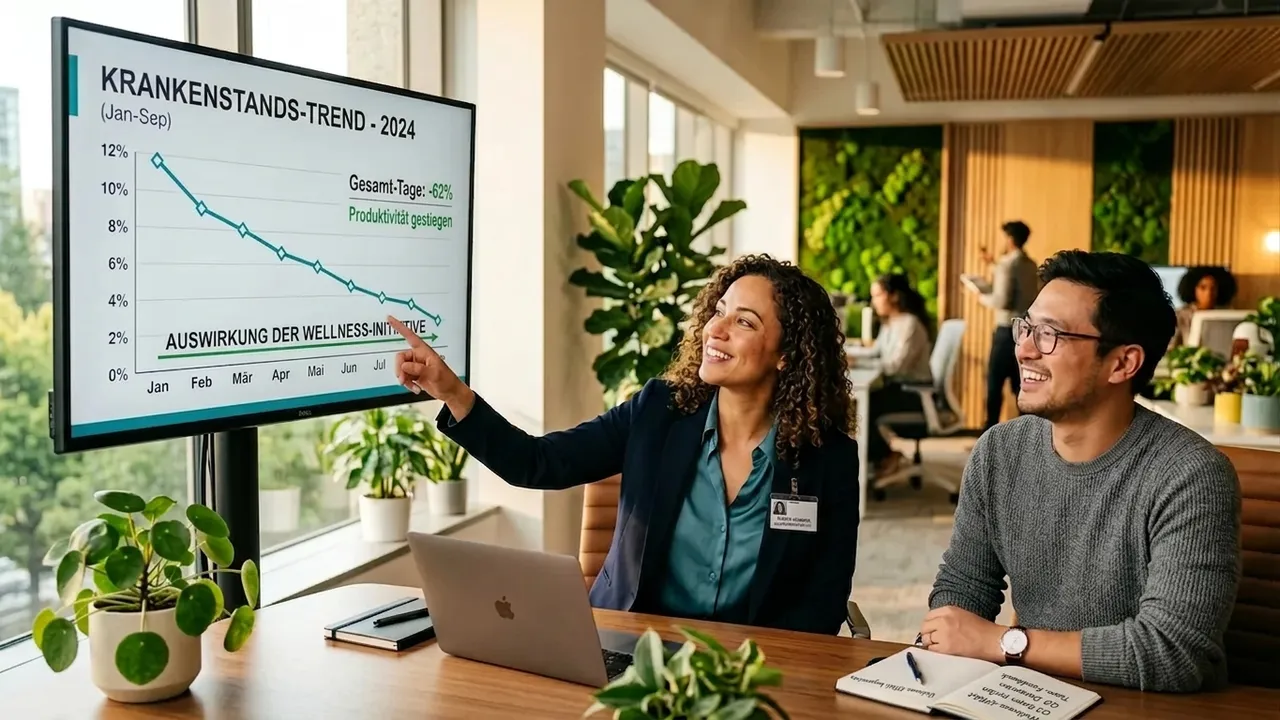
Structured BGF measurably reduces absenteeism — the iga.Report finds a median ROI of about 1:2.7. Three main levers: activity (subsidized under German law, §20b SGB V), healthy leadership, and easing psychological strain. Isolated actions achieve little.
The 5 most common causes of high absenteeism and what works against them
| Cause | Typical BGF Measure | Cost | Effect after |
|---|---|---|---|
| Musculoskeletal complaints (back, neck) | Back-care courses, height-adjustable desks, activity challenges | from €0 (reimbursed by German statutory health insurers) up to ~€150/employee | 3–6 months |
| Psychological strain / burnout | Resilience courses, mindfulness workshops, leadership training | €50–200/employee | 6–12 months |
| Colds / respiratory illnesses | Vaccination campaigns, occupational physician consultations, hand hygiene | €5–30/employee | 1–2 seasons |
| Cardiovascular / diet-related | Nutrition counseling (ZPP-certified, reimbursed by German statutory health insurers), fruit baskets | from €0 (statutory health insurance) up to ~€80/employee | 12–24 months |
| Poor leadership culture / conflicts | Leadership coaching, team building, feedback routines | €300–1,500/group | 6–18 months |
What's really driving sick leave?
According to the BKK Gesundheitsreport (BKK health report), musculoskeletal disorders account for around 22% of all sick days — followed by mental health disorders (15%) and respiratory illnesses (12%). These three areas are also the ones where BGF (workplace health promotion) has the strongest leverage.
An often-overlooked factor: absenteeism frequently has a social component. Studies show that employees with high job satisfaction and a sense of appreciation have up to 40% fewer short-term absences — independent of their physical health. Leadership isn't a soft topic; it's a measurable driver of absenteeism.
Short-term one-off actions like an annual health day fizzle out without effect if they aren't embedded in a documented BGM (occupational health management) process. The difference: a process first analyzes the specific strain hotspots within your own company before measures are planned.
Which BGF measures measurably reduce absenteeism?
The iga.Report (Initiative Gesundheit und Arbeit) evaluated over 1,000 studies: behavioral and structural interventions combined achieve the strongest effects. Individual course offerings without a structural framework barely reduce absenteeism.
Physical activity programs (running groups, yoga, step-counter challenges) show an ROI of up to 1:3 — especially when they're social and involve colleagues. The Nexus ecosystem offers two concrete options with Aktive Firma and Pimp my Firmenlauf, which integrate directly into the BGF-Kompass activity focus area.
Nutrition interventions with ZPP certification (e.g., Upfit) are reimbursable by German statutory health insurers under §20b SGB V, making them effectively cost-neutral for the employer. They have proven effects on body weight, blood pressure, and, in turn, cardiovascular-related absences.
Psychological safety and stress reduction work more slowly, but more sustainably: companies that train managers in health-promoting leadership behavior report reductions in absenteeism of 8–15% after 12–18 months (Bertelsmann Stiftung, 2022).
The role of healthy leadership
The iga.Report identifies leadership behavior as the single most important factor for employee health — even ahead of concrete program offerings. Managers who show appreciation, set clear expectations, and actively address overload create the healthiest work environment.
This doesn't mean managers need to be therapists. Concretely: regular 1:1s, transparent workload distribution, consistent vacation planning, and normalizing asking for help are the decisive behaviors.
BGF-Kompass includes measures in the Healthy Leadership focus area that are directly bookable for managers and measurable for BGF reporting.
What you can do today
First step: analyze instead of guess. The BGF Maturity Check (5 minutes, 11 questions) shows which focus areas are most likely causing your sick leave — based on your company's structure, not generic statistics.
Second step: start a cost-neutral measure. ZPP-certified offerings (e.g., nutrition counseling, back-care courses) are subsidized by German statutory health insurers under §20b SGB V. Combined with the €600 tax allowance under §3 Nr. 34 EStG (German Income Tax Act), the first step is, for most SMEs, effectively free of net cost. Note: these figures reflect German law and tax regulations and may not apply outside Germany.
Third step: track the absenteeism rate as a KPI. BGF-Kompass records participation rates and links them to the BGF Score — turning a single measure into a measurable contribution to organizational health.
Related measures & topics
Key takeaways
- Note: legal and tax references in this guide (e.g., §20b SGB V, §3 Nr. 34 EStG) reflect German law. Musculoskeletal issues, mental health, and leadership culture are the three biggest drivers of absenteeism — BGF has direct influence on all three.
- One-off actions without a process achieve little. What matters is a documented BGM process that links analysis, planning, and evaluation.
- ZPP-certified measures are reimbursable by German statutory health insurers (§20b SGB V) — the first steps are effectively cost-neutral for most SMEs.
- Leadership behavior is the single strongest factor for employee health — BGF without a leadership component falls short of its potential.
- The BGF Maturity Check (5 min) shows where to start — before resources flow into the wrong measures.
Frequently asked questions
From how many employees does a BGF program against high sick leave pay off?+
Structured BGF programs make economic sense starting at as few as 20–30 employees. A single avoided long-term absence (>6 weeks) covers the BGF costs for an entire year. At 50+ employees, professional platforms like BGF-Kompass typically pay for themselves within 6–12 months.
How quickly does sick leave drop after introducing BGF?+
The first measurable effects appear after 3–6 months for physical programs (activity, ergonomics). Psychological and cultural measures work more slowly — significant reductions are realistic after 12–18 months. Consistency is key: one-off actions without a process have no lasting effect.
Which health insurers subsidize BGF measures?+
Under German law (§20b SGB V), all statutory health insurers are required to support workplace health promotion. Whether and to what extent they subsidize a specific measure is up to the insurer — the prerequisite is that the measure complies with the GKV Prevention Guide or is ZPP-certified.
Do I need to measure sick leave to start BGF?+
No. BGF doesn't require a perfect data foundation. It's enough to start with a needs assessment (e.g., a short employee survey or the BGF Maturity Check). The absenteeism rate is then incorporated as a KPI during the ongoing BGF process.
What's the difference between presenteeism and absenteeism?+
Absenteeism describes being absent from work (the sick leave rate). Presenteeism means being present but working at reduced capacity — for example, due to pain or mental exhaustion. Studies show presenteeism costs two to three times as much as absenteeism. BGF programs address both phenomena.
Where's your biggest lever for reducing sick leave?
The BGF Maturity Check shows in 5 minutes which focus areas have the biggest impact on absenteeism in your company — and which measures you can start right away.
Sources
- BKK Dachverband – Health Report 2023 ↗
- iga.Report – Effectiveness and Benefits of Workplace Prevention ↗
- Bundesgesundheitsblatt – BGF in Small and Medium-Sized Enterprises ↗
Last updated: 2026-06-23. Not legal or tax advice — have your specific case reviewed by a professional.