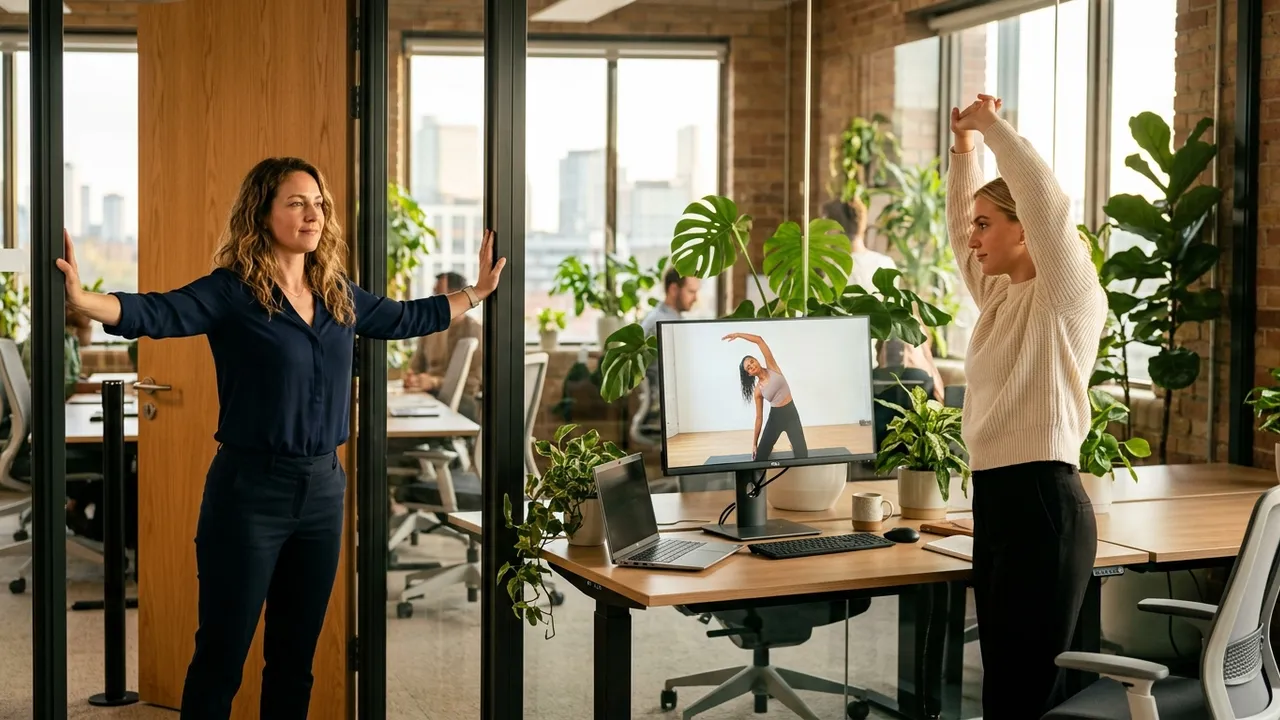
A movement break without a fixed time: how it survives even in dispatch
In dispatch, customer service and shift work, movement programmes rarely fail because people are unwilling – they fail because of the calendar. When the truck is stuck at customs or the phones are running hot, the shared 2 p.m. slot is the first thing to go. A guided 10-minute session right at the workplace solves this by doing without a fixed time and placing the commitment in a reminder instead.
Why the fixed slot is the problem, not the solution In rhythm-driven areas a shared time is not a motivation criterion but an exclusion criterion: anyone who cannot make it is out – and permanently, because missing it twice gets filed away as 'not made for me'. The alternative gives everyone the choice: first thing in the morning, after lunch, or as an afternoon reset. So the session does not simply vanish under the pressure of the day, the platform reminds those who have not yet done it that afternoon. The reminder does not replace motivation – it replaces the calendar entry.
The sequence: head to toe, breathing exercise at the end 12 clips of around 40 seconds each run in a fixed order. The eyes come first: after hours at the same distance from the screen, they deliberately switch between far and near. Then spine and neck – seated cat-cow, upper-body rotation, side bend. Next come the shoulders, the chest at the door frame and against the wall, and finally the legs: calf stretch and calf pump bring back the circulation that pools in the legs after hours of sitting. A breathing exercise brings the nervous system down, so people return to their desk focused rather than wired; a short finger exercise rounds things off for hands that are about to type again. Every exercise is narrated in six languages, with subtitles.
As a measure or as a health app The Active Break at the Office can be started as a measure for the whole company – with an announcement, reminders and evaluation in the dashboard – or offered permanently as a health app that everyone uses whenever they like. Both run in the employee portal, where the videos are played. The portal is included from the Starter plan.
The one sentence leadership has to say Without an explicit statement many people will not take the break – worried it might read as slacking off. The clarification 'These 10 minutes are working time, use them whenever it fits today' costs nothing and decides whether the measure runs at all. Equally effective: managers who visibly join in. Anyone who sees them standing at the door frame once needs no further permission.
How you know it has landed Not from the participation rate on the dashboard, but from someone standing up mid-afternoon, stretching at the door frame – and nobody looking up any more. The rest is equipment: no changing, no devices, a door frame and a free stretch of wall are enough. That is precisely why the session does not break the working rhythm.
How to put it in place
- 1Start it as a measure or switch it on as a health app in the employee portal (Starter and up)
- 2Choose a compliance mode (auto-end / click-at-end / click-at-40s)
- 3Recommend the reminder — it is the difference between “I meant to” and “done”
- 4Inform employees — everyone subscribes on their own and picks their own moment
What you need
- Effort
- under 30 min
- Cost
- Free
- Duration
- täglich rund 10 Minuten
- Setup
- 5 min
- ✓ One guided session of about 10 minutes — no piecing together individual exercises
- ✓ Fixed order from head to toe, breathing and finger exercise at the end
- ✓ Audio and subtitles in six languages — everyone hears the instructions in their own language
- ✓ Freely chosen moment — the reminder is the safety net
Eligible for funding: up to €600 tax-free
As part of a structured workplace health process, this measure is tax-free under § 3 no. 34 of the German Income Tax Act (EStG) up to €600 per employee per year — BGF-Kompass supplies the process. Certified offers (e.g. from Upfit) are additionally subsidised by statutory health insurers under § 20b SGB V.
Health-insurer funding & tax: how to apply →Adopt it for your company
Register for free — and the measure is ready to go in your cockpit: invitation, feedback survey and appointment are already set up. First cycle, first numbers for the boss.
Start for free nowRather take a look first? To the live demo →
Contributes to
Measure the impact with
Action field
Physical Activity →A fitting occasion
Related best practices
Not sure where to start? 5-minute self-check →